
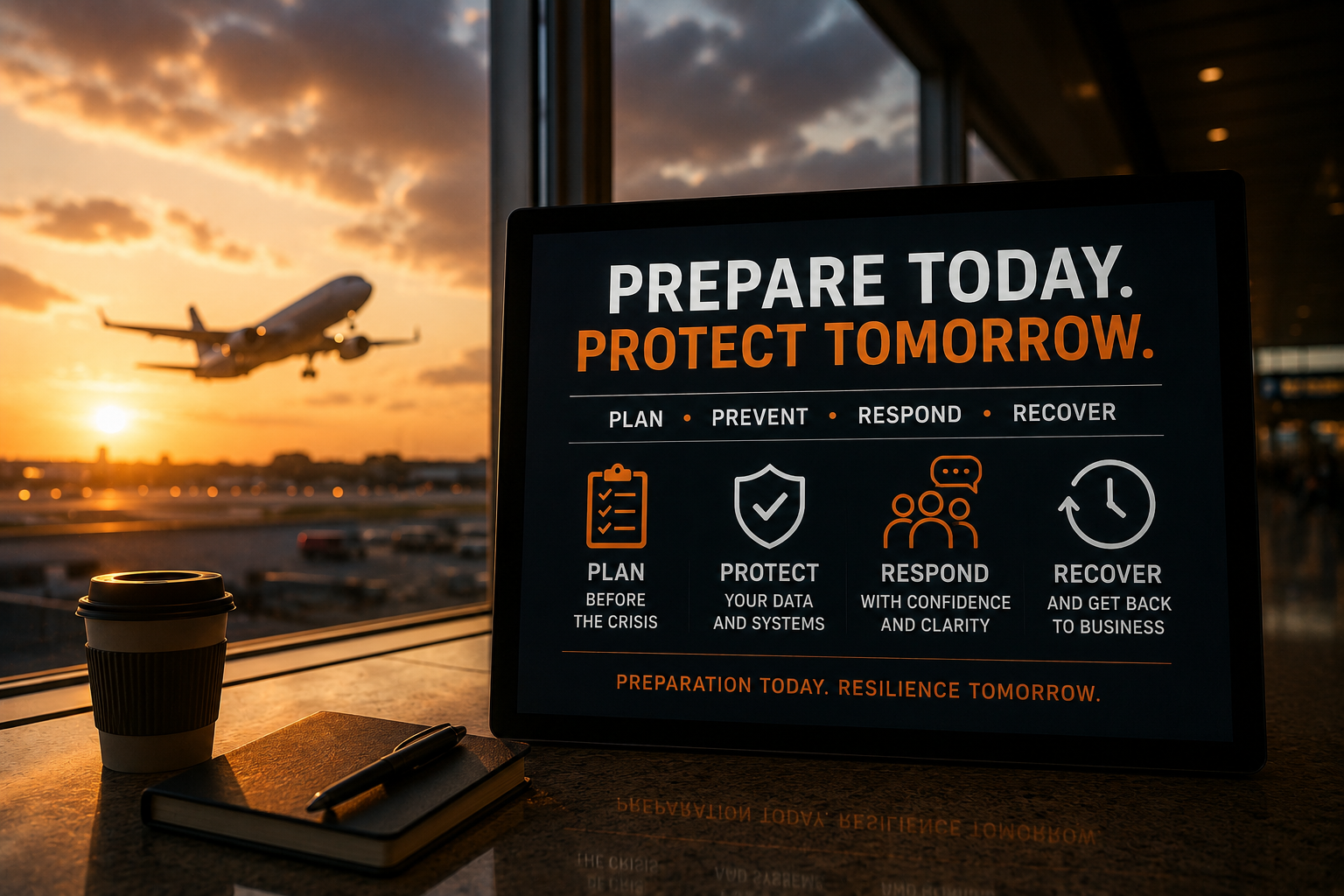
Imagine you're on a commercial flight when the plane suddenly encounters severe turbulence. As passengers grip their armrests, the last thing anyone wants to hear is the pilot say, "Give me a minute—I haven't dealt with this before."
Fortunately, that's never the case.
Pilots spend thousands of hours training for emergencies they hope they'll never experience. They practice engine failures, severe weather, emergency landings, and countless other scenarios long before they're responsible for hundreds of lives. When something unexpected happens, they don't stop to create a plan—they execute one they've already practiced.
Successful businesses should approach technology disasters the same way.
At Capstone IT, we've found that many organizations invest heavily in cybersecurity, cloud services, and data backups but spend very little time preparing for what actually happens when those systems fail. The technology may be in place, but the recovery plan often isn't.
Unfortunately, emergencies don't wait until your business is ready.
A ransomware attack can lock employees out of critical systems. A failed server can bring operations to a standstill. A power outage during hurricane season can interrupt communications across your entire organization. Even something as simple as an internet outage or failed software update can leave employees unable to serve customers.
For businesses across Palm Beach, Martin, and St. Lucie Counties, these situations aren't hypothetical. Every hurricane season reminds us how quickly normal operations can change.
The real challenge isn't always the disruption itself.
It's everything that follows.
When systems suddenly become unavailable, leadership begins asking questions that should already have answers.
Who is responsible for coordinating the recovery?
Which business applications must come back online first?
How long can employees continue working without access?
How will customers be informed?
Who is communicating with vendors, employees, and clients?
Without a documented and tested disaster recovery plan, every decision has to be made in real time. That uncertainty creates delays, confusion, and unnecessary downtime while employees wait for direction instead of taking action.
Those delays quickly become expensive.
Productivity slows as employees lose access to critical applications. Customer service teams struggle to respond to requests. Sales opportunities are missed, internal communication becomes fragmented, and customer confidence begins to erode.
Ironically, the technology itself often isn't the biggest problem.
The biggest problem is that no one has practiced responding to the situation.
Consider two companies experiencing the exact same outage.
Both lose access to their systems at 9:00 Monday morning.
The first company has a documented business continuity plan. Their leadership team knows exactly who is responsible for each step. Critical applications have already been prioritized. Employees understand the communication process, and customers receive timely updates throughout the recovery.
The second company starts asking questions.
Who's calling the IT provider?
What should we restore first?
How long will this take?
Should we notify customers now or wait?
Hours pass while decisions are debated, turning what could have been a manageable disruption into a major business crisis.
The difference wasn't better technology.
The difference was preparation.
Business continuity planning isn't about expecting disaster every day. It's about recognizing that unexpected events eventually happen to every organization. Whether the disruption comes from ransomware, human error, hardware failure, or a major South Florida storm, your response determines how quickly your business recovers.
Organizations that recover the fastest are rarely the ones with the largest IT budgets. They're the ones that have invested time in creating, documenting, and testing their disaster recovery strategy before they ever need it.
At Capstone IT, we help businesses throughout the Treasure Coast and Palm Beaches develop practical Business Continuity and Disaster Recovery (BCDR) plans that reduce downtime, protect critical data, and keep employees productive during unexpected events. We don't simply install technology—we help organizations prepare for the moments when that technology is put to the test.
Because when an emergency happens, your team shouldn't be creating a plan.
They should already be executing one.
Is Your Business Ready?
If your organization experienced a major technology outage tomorrow, would your team know exactly what to do?
Capstone IT offers a complimentary Business Continuity & Disaster Recovery Assessment to help identify gaps in your current recovery strategy, evaluate your backup and disaster recovery plan, and ensure your business is prepared for whatever comes next.
Contact us today to schedule your consultation and gain confidence that your business can recover quickly when it matters most.