Technology shouldn't be something you only think about when it breaks.
Unfortunately, that's exactly how many businesses approach IT.
They sign a managed services agreement, onboard a provider, and assume someone else is taking care of everything behind the scenes. Then twelve months later, renewal paperwork arrives, someone asks if everything is going well, and the answer is usually something along the lines of:
That's not really an IT strategy.
It's crossing your fingers.
For businesses throughout Palm Beach County and the Treasure Coast, technology changes far too quickly to operate on assumptions. Cybercriminals evolve. Software vendors release updates. Employees come and go. New tools get adopted. Compliance requirements shift. Before long, the environment you have today looks very different from the one you had three months ago.
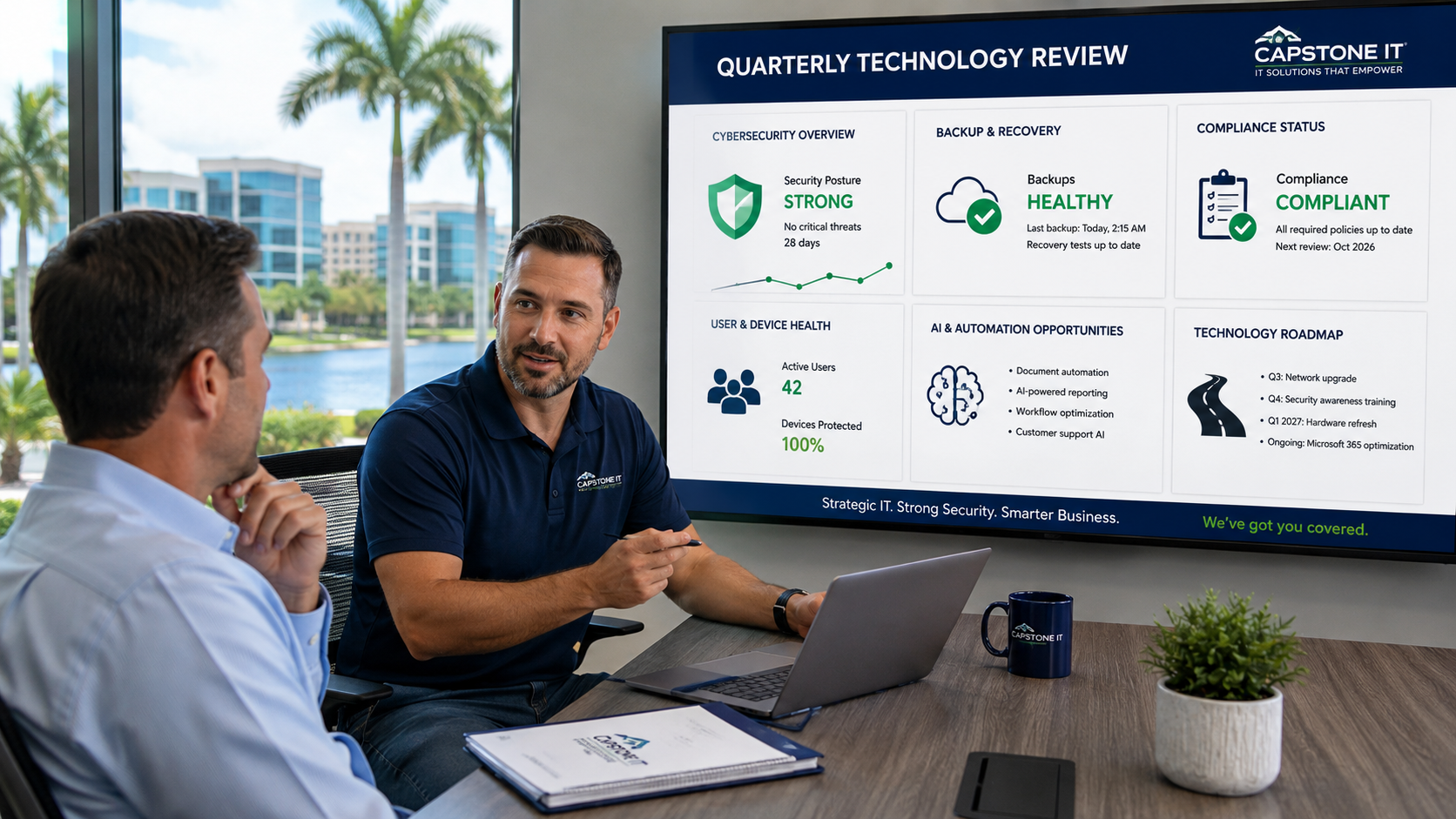
That's why we believe quarterly technology reviews aren't optional.
They're one of the most valuable conversations a business owner can have.
But most business leaders aren't sure what they should be asking.
Here are six questions every business should ask their IT provider at least once every quarter.
1. What Security Risks Should We Address Right Now?
No business is perfectly secure.
The important question isn't whether vulnerabilities exist.
It's whether someone is actively looking for them before attackers do.
A good IT provider shouldn't simply say:
They should be able to tell you:
- Have there been unusual login attempts?
- Are users bypassing security controls?
- Are systems missing patches?
- Are devices operating outside company standards?
- Has anything changed since the last review?
Specificity matters.
You want an advisor who can say:
Cybersecurity isn't static.
Neither are the threats facing South Florida businesses.
2. Have You Tested Our Backups Recently?
Most businesses believe they have backups.
Far fewer know whether they can actually recover.
There's a difference.
Backups sitting quietly in the background feel reassuring until someone accidentally deletes a file, a server fails, or ransomware encrypts everything.
Then the questions start.
Who restores it?
How long will it take?
What data is recoverable?
Will employees be down for hours?
Days?
Weeks?
Ask your provider:
- When was the last recovery test?
- How long would restoration realistically take?
- Is Microsoft 365 protected?
- Are backups isolated from ransomware attacks?
- Who owns the recovery process?
During an outage isn't the time to discover you're relying on assumptions.
3. Where Is Technology Slowing Us Down?
Not every technology problem creates an emergency.
Most create frustration.
Employees waiting twenty seconds for applications to load.
Video calls freezing.
Systems that everyone quietly avoids using because they no longer work reliably.
Over time, these small annoyances cost businesses significant amounts of productivity.
Ask:
- What systems receive the most complaints?
- Is our hardware aging?
- Have we outgrown our current setup?
- Are there quick improvements that would make our team more efficient?
Technology should help employees move faster.
Not train them to accept inconvenience.
4. Are We Still Compliant?
Compliance isn't something businesses complete once and forget about.
Requirements evolve.
Insurance carriers tighten standards.
Clients ask tougher questions.
Industries adopt new frameworks.
Whether you're dealing with:
- HIPAA
- Cyber insurance requirements
- PCI-DSS
- Vendor questionnaires
- Financial regulations
- Legal industry standards
A company that was compliant last year can easily drift out of alignment.
Ask your provider:
- Have requirements changed?
- Are policies current?
- Do employees need updated training?
- Is documentation complete?
- Are security controls adequate?
The cost of non-compliance rarely ends with fines.
It impacts trust.
Contracts.
Insurance claims.
Reputation.
5. What Should We Budget For?
One of the biggest differences between a reactive IT company and a strategic partner is planning.
Good providers know what's coming.
They track:
- Expiring warranties
- Aging servers
- Computer replacement cycles
- Microsoft licensing changes
- Security investments
- Upcoming projects
Quarterly planning spreads costs out.
It prevents surprises.
And it keeps businesses from making emergency purchases that wreck budgets.
For growing businesses throughout Palm Beach Gardens, Stuart, Jupiter, Port St. Lucie, and West Palm Beach, thoughtful budgeting can mean the difference between scaling confidently and constantly playing catch-up.
6. Where Are We Falling Behind?
This may be the most important question.
And it's one many providers avoid.
Because it requires strategic thinking.
Ask:
- What technologies should we be exploring?
- Are competitors adopting tools we're missing?
- Could AI help our team?
- Are there cybersecurity best practices we haven't implemented?
- What trends should we prepare for?
Technology changes quickly.
Cybercriminals move even faster.
A good technology partner helps businesses stay ahead of both.
If You're Not Having These Conversations, Consider It a Red Flag
If your IT company isn't proactively meeting with you every quarter...
If they don't bring recommendations...
If they struggle to answer these questions...
You may not be getting the partnership your business deserves.
At Capstone IT, we believe our role goes beyond fixing computers.
We're here to help businesses across the Treasure Coast and Palm Beaches reduce risk, improve efficiency, strengthen cybersecurity, and make smarter technology decisions before small issues become expensive problems.
Schedule a Complimentary Technology Review
If you'd like a straightforward conversation about what's working, what's not, and where opportunities may exist, we'd love to help.
Call Capstone IT at (561) 257-1879 or schedule a quick discovery call.
Because technology shouldn't be something you think about only when it breaks.
It should be helping your business move forward every day.