January feels like it was yesterday.
But think about everything that's happened since then.
Maybe you've hired new employees, signed on new clients, implemented a CRM, experimented with AI tools, added a vendor, or expanded remote work. Maybe someone changed roles, picked up additional responsibilities, or inherited access to systems because it was easier than setting up something new.
Your business hasn't stood still.
And neither have your systems.
The challenge is that while businesses intentionally plan for growth, they rarely revisit the technology decisions made along the way. By July, many businesses throughout Palm Beach County and the Treasure Coast are operating on assumptions about how their systems work, who has access, where data lives, and who is responsible when something goes wrong.
Those assumptions can become expensive.
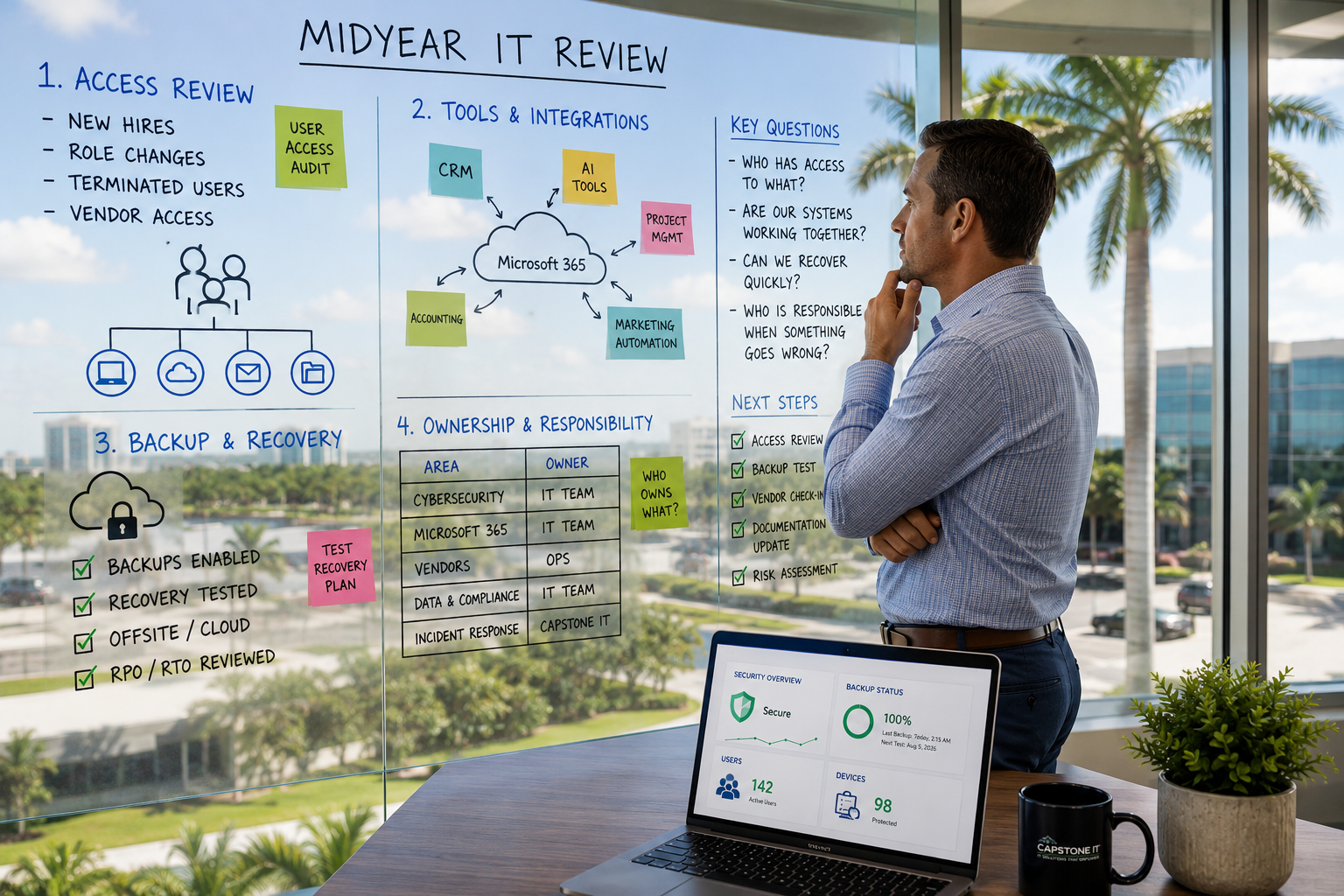
Access Was Expanded. But Was It Ever Reviewed?
Growth usually requires speed.
Someone starts on Monday and needs access immediately. An employee moves into a new role and keeps permissions from their previous position. A vendor receives temporary credentials to complete a project. Someone covers for a coworker who is out on vacation.
Then everyone moves on.
The problem is that access rarely gets revisited once it has been granted.
Over time, businesses often discover that employees have permissions they no longer need, former team members still have active accounts, vendors retain access long after projects have wrapped up, and no one has a complete picture of who can access what.
At Capstone IT, we've found that most business owners can tell us their revenue numbers, employee count, and top clients in a matter of seconds. But when we ask who currently has administrative access to Microsoft 365 or who can see sensitive company information, the answer is often much less clear.
If understanding who has access to your systems takes longer than a few moments, it may be worth taking a closer look.
New Tools Solved Problems While Creating New Ones
Every software purchase begins with good intentions.
Marketing needed better automation. Sales wanted more visibility into prospects. Accounting wanted to streamline billing. Operations needed a better way to manage projects.
Individually, these are smart business decisions.
Collectively, they can create complexity.
Data becomes spread across multiple platforms. Integrations are configured quickly and then forgotten. Reports don't match. Employees start creating workarounds because systems don't communicate the way they were intended to.
The biggest risk isn't necessarily that something is broken.
It's that no one owns the entire picture.
Ask yourself this:
Are your systems supporting your team?
Or has your team quietly learned to work around them?
By the time that question feels urgent, it's probably been an issue for much longer than anyone realized.
Your Confidence in Backups May Be Based on Hope
Most businesses have backups.
Far fewer regularly test them.
Even fewer know exactly how long it would take to restore operations if something went wrong.
And that distinction matters.
Because when ransomware strikes, a server fails, or an employee accidentally deletes important files, the conversation changes quickly.
Suddenly, everyone is asking:
"Who handles this?"
"How recent is our backup?"
"How long will employees be down?"
"Can we recover everything?"
Having backups and being able to recover are two very different things.
Recovery is a process, and processes should be tested before they're needed.
For businesses throughout Stuart, Palm City, Jupiter, Port St. Lucie, and West Palm Beach, one simple question can reveal a lot:
If your systems went down tomorrow morning, would everyone know exactly what happens next?
Or would you be figuring it out under pressure?
Responsibilities Become Blurry as Businesses Grow
Remember when everyone knew exactly who was responsible for what?
Accounting managed accounting software.
Operations managed vendors.
IT handled technology.
Employees knew who to call.
Then the business grew.
New vendors came onboard. Additional software was added. Responsibilities shifted. Cloud applications multiplied.
Somewhere in the middle of all that growth, ownership became fuzzy.
Today, many businesses struggle to answer basic questions:
Who manages cybersecurity?
Who oversees Microsoft 365?
Who works with vendors?
Who updates documentation?
Who coordinates a response if something serious happens?
And if the answer is simply, "We'll figure it out when it happens," that may not be the plan you want.
Most Risk Doesn't Come From What's Broken
It comes from what's changed without being revisited.
Businesses that stay ahead aren't necessarily doing anything extraordinary.
They simply maintain clarity.
They know who has access, where their data lives, that their backups work, and who owns what.
That clarity allows them to grow confidently without letting small gaps quietly turn into major problems.
At Capstone IT, we help businesses throughout Palm Beach Gardens, Jupiter, Stuart, Port St. Lucie, West Palm Beach, and the Treasure Coast gain visibility into their technology environment—not because something is broken, but because we'd rather help you identify gaps now than explain them later.
Call Capstone IT at (561) 257-1879 to schedule a quick discovery call. We'll help you understand what's changed, what's working, and what may need attention before it becomes a problem.