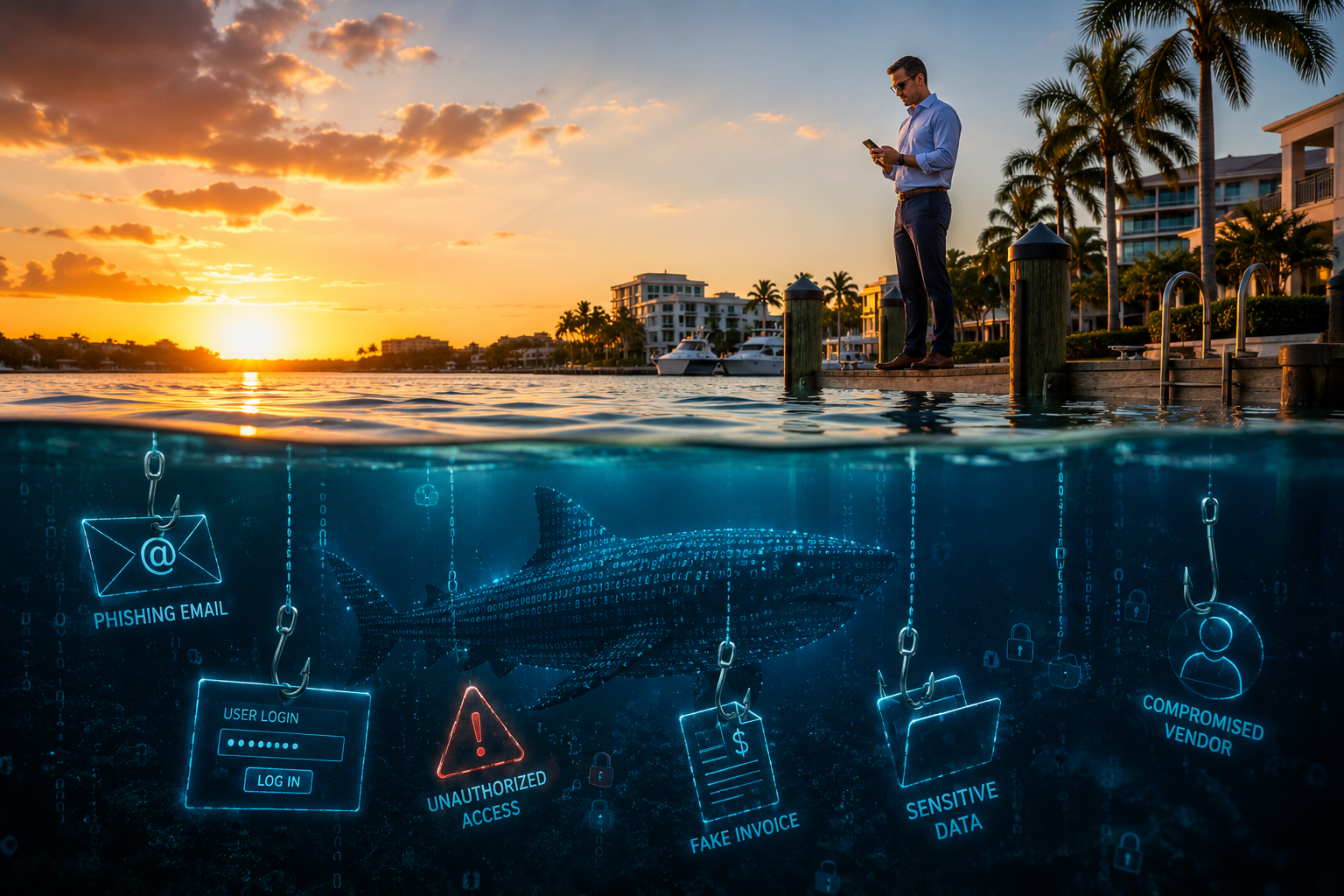
On the surface, the water looks calm.
That's probably one of the reasons Shark Week has remained popular for nearly four decades. The danger isn't usually visible. It's not splashing around or announcing itself.
It's already moving underneath.
Cybercriminals operate much the same way.
The biggest threats facing businesses today aren't always loud. They don't typically start with flashing red warning signs or dramatic system failures. Most are intentionally designed to blend in with everyday business operations until the moment money moves, credentials are stolen, or systems suddenly become unavailable.
And during the summer months, attackers know something many business owners don't think about.
People get distracted.
Employees travel.
Approvers go on vacation.
Schedules become less structured.
Oversight gets thinner.
For businesses throughout Palm Beach County and the Treasure Coast, summer can be one of the busiest times of year. It can also be one of the easiest times for cybercriminals to slip through unnoticed.
Here are three ways they're circling right now.
Fake Invoices and Vendor Impersonation
Attackers don't always need sophisticated hacking tools.
Sometimes they only need one believable email.
Business Email Compromise, often referred to as BEC, continues to be one of the most effective attack methods because it takes advantage of trust rather than technology.
The email appears to come from a vendor you've worked with for years.
A supplier.
An attorney.
Your accountant.
Even your CEO.
The wording feels normal.
The logo looks legitimate.
The sense of urgency seems reasonable.
Someone on your team processes the payment.
A few days later, everyone realizes the money was sent somewhere it should never have gone.
Summer months make these attacks even more successful.
The person who normally approves invoices may be out of town.
Requests get rerouted.
Employees covering responsibilities don't always know what looks normal.
And attackers know it.
Fortunately, the solution doesn't require expensive software.
It requires process.
One quick phone call to a known number—not the number listed in the email—is often enough to stop these attacks before they start.
Phishing Attacks Target Distracted Employees
Phishing doesn't work because employees aren't smart.
It works because employees are busy.
Cybercriminals understand human behavior surprisingly well.
They know people multitask.
They know meetings stack up.
They know everyone wants to be efficient.
So they create scenarios designed to take advantage of that.
A password reset notification arrives.
A text message appears to come from IT.
An email requests urgent approval right before lunch.
A wire transfer request shows up minutes before a meeting starts.
Nobody intends to make a bad decision.
They simply don't stop long enough to verify.
At Capstone IT, we tell clients that one of the strongest cybersecurity tools available today isn't software.
It's culture.
Employees should feel comfortable slowing down.
Asking questions.
Double-checking requests.
Pausing before clicking.
Because speed is one of the biggest weapons cybercriminals have.
Teaching employees that it's okay to slow down takes that advantage away.
Third-Party Risks Travel Faster Than You Think
Many businesses assume that if a vendor gets compromised, it's the vendor's problem.
Unfortunately, that's not how cybersecurity works.
If someone has access to your systems, your data, or your Microsoft 365 environment, their security posture becomes part of yours.
This is called supply chain exposure.
And most businesses have far more of it than they realize.
Software vendors.
Contractors.
Marketing agencies.
Payroll companies.
Consultants.
Temporary providers.
Old integrations.
Projects completed years ago.
Many of these relationships still maintain some level of access long after everyone has forgotten about them.
Outsourcing a service doesn't outsource accountability.
Every business owner should be able to answer three simple questions:
Who has access to our systems?
What can they access?
Who internally owns that relationship?
If those answers aren't easy to find, there may be more exposure beneath the surface than you realize.
By the Time You See It, It's Already Moving
Sharks don't announce themselves.
Neither do cybercriminals.
Businesses that experience incidents aren't always ignoring obvious warning signs.
More often, they're simply operating under the assumption that everything is fine because nothing looks wrong.
Summer schedules become flexible.
People travel.
Employees cover responsibilities.
Attention drifts.
And the water looks calmest.
That's also when attackers tend to be most active.
At Capstone IT, we help businesses throughout Palm Beach Gardens, Jupiter, Stuart, Palm City, Port St. Lucie, West Palm Beach, and the Treasure Coast identify hidden risks before they become expensive incidents.
Because cybersecurity isn't just about responding after something happens.
It's about understanding what's already moving underneath.
Schedule a Complimentary Cybersecurity Review
Call Capstone IT at (561) 257-1879 or schedule a quick discovery call.
We'll help you identify hidden exposures, review vendor access, evaluate employee security habits, and better understand where risks may exist before they surface.
Because attackers don't wait for weaknesses.
They wait for silence.